Friday, August 23, 2013

The Normal A1C Level


You wish to control your diabetes as abundant as possible. You wouldn't be reading this if you did not.

So you often check your A1C level. This is the best measurement of our blood glucose management that we have currently. It tells us what proportion of our hemoglobin -- the protein in our red blood cells that carry oxygen -- has glucose sticking to it. The less glucose that remains in our bloodstream instead of going to work within the cells that need it the higher we have a tendency to feel now and the higher our health will still be.

As we have a tendency to are able to manage our diabetes higher and higher, the reasonable goal is to bring our A1C levels right down to normal -- the A1C level that individuals who don't have diabetes have. However before we have a tendency to can even set that goal, we have a tendency to have to know what the target is.

The bother with setting that target is that completely different experts tell us that quite completely different A1C levels are "traditional." They tell us that different levels are traditional -- but I actually have never heard of actual studies of traditional A1C levels among people without diabetes -- until currently.

The major laboratories that test our levels typically say that the normal vary is 4.zero to 6.zero. They base that range on an previous normal chemistry text, Tietz Fundamentals of Clinical Chemistry.

The Diabetes Management and Complications Trial or DCCT, one in all the two largest and most vital studies of people with diabetes, said that half dozen.0 was a traditional level. But the other key study, the United Kingdom Prospective Diabetes Study or UKPDS, that compared conventional and intensive therapy in additional than 5,zero0zero newly diagnosed people with kind 2 diabetes, said that half-dozen.two is the normal level.

Those levels, whereas unsubstantiated, are close. However then comes along one of my heroes, Dr. Richard K. Bernstein, the author of the key text of terribly low-carb eating for people with diabetes, Dr. Bernstein's Diabetes Solution. Dr. Bernstein himself developed kind 1 diabetes in 1946 at the age of 12.

"For my patients...a really normal HgbA1C ranges from four.2 p.c to 4.half-dozen %," he writes on page 54 of the third edition of that book. "Mine is consistently four.5 p.c." Then in his July thirty, 2008, telecast he reiterated that as far as he has been in a position to determine, a traditional A1C is 4.a pair of to four.6.

What Dr. Bernstein says is traditional is thus at odds with the other specialists that at least a year ago I determined to search out scientific proof of what a normal A1C level really is. It turned out to be a heap a lot of troublesome to find than I ever imagined.

My personal quest for a traditional A1C level and that of my favorite Certified Diabetes Educator drove that search.

When I learned in 1994 that I had diabetes which my A1C level was 14.four, I was gradually in a position to bring it manner down. Lately I even have been doing everything I can assume of to try to induce my A1C down to traditional. But in 2008 my level in 9 separate A1C tests forever ranged from five.2 to five.6. That's so much from traditional, per Dr. Bernstein.

Sunday, August 18, 2013

hemoglobin a1c chart

What is a hemoglobin A1c (A1c)?
To make a case for what an A1c is, think in simple terms. Sugar sticks, and when it's around for a while, it's tougher to get it off. In the body, sugar sticks too, notably to proteins. The red blood cells that flow into in the body live for about three months before they die. When sugar sticks to those cells, it offers us an idea of how a lot of sugar has been around for the preceding 3 months. In most labs, the conventional range is 4-five.nine %. In poorly controlled diabetes, its 8.zeropercent or above, and in well controlled patients it's less than 7.zeropercent. The benefits of measuring A1c is that is provides a a lot of reasonable view of what is happening over the course of your time (3 months), and the worth will not bounce as abundant as finger stick blood sugar measurements.

a1c chart,hemoglobin a1c chart,a1c levels,blood sugar chart,normal a1c,a1c levels,a1c foods to eat,what is a1c ,a1c diabetes,a1c calculator,a1c blood test
 hemoglobin a1c chart
We tend to all are aware that hemoglobin is the protein molecule that consists within the red blood cells of the body. Hemoglobin is accountable for carrying the oxygen from the lungs to other parts of the body, and in come back, carrying carbon dioxide to the lungs. People who have elevated sugar levels within the body tend to have glycated hemoglobin. We have a tendency to all are aware that after sugar sticks to a surface, it is very troublesome to get rid of it. The same thing applies in the body likewise. The elevated sugar levels in the body makes the excessive sugar persist with the hemoglobin and kind a layer on it, and the hemoglobin A1c check determines the terribly same quantity! The lifespan of a red blood cell is about one hundred twenty days, that means, that the hemoglobin A1c take a look at will help confirm the blood sugar levels within the body for almost the past 3 months. Thus, this take a look at is more trusted and accurate as compared to the regular glucose monitoring at home. That is why consultants suggest this check to be the first test for the diagnosis and management check for diabetes.


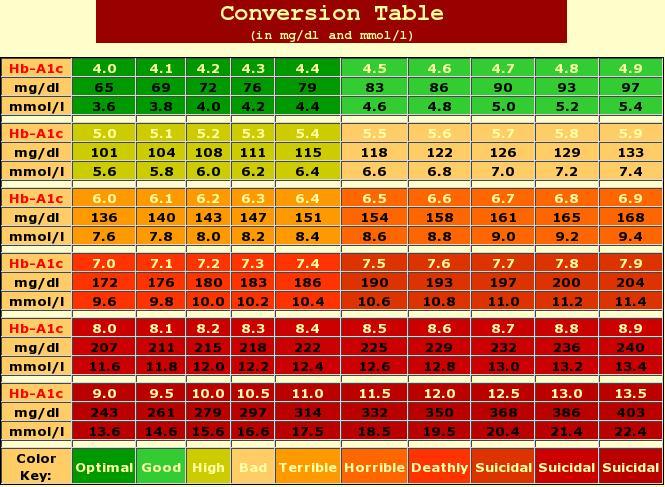
Hemoglobin A1c testing is one positive manner to make positive that you are keeping your blood sugar levels below control. Unlike different glucose tests, diabetes HbA1c check incorporates a memory. The great factor regarding hemoglobin A1c testing is that it averages your blood sugar levels for the past a pair of - 3 months, supplying you with a additional complete read of your overall health. The higher your average blood glucose level, the higher the HbA1c check. See the comparison chart below to determine how hemoglobin A1c testing corresponds to average blood sugar levels:

HbA1c Reading
Average Blood Sugar Level
Your Blood Sugar Control
14%360 mg/dLVery poor control, take immediate action to lower
10%240 mg/dLPoor control, take action to lower
9%210 mg/dLPoor control, take action to lower
8%180 mg/dLMarginal control, take action to lower
7%150 mg/dLGood control
6%120 mg/dLVery good control
Anyone with diabetes should have the HbA1c test done every 6 months. If you inject insulin, you should have the test done every 3 months.

The hemoglobin A1c check helps a lot in monitoring and controlling the blood sugar levels in diabetes. A constant check up for the same allows the patient to steer a balanced and healthy diabetic life. Another issue to be noted is that the hemoglobin A1c range additionally varies from laboratory to laboratory, therefore it'd be advisable to ask your physician about your actual take a look at results that means. Have a safe tomorrow!

While there are not any pointers to use A1c as a screening tool, it offers a physician a good idea that someone is diabetic if the worth is elevated. Right currently, it is used as a normal tool to work out blood sugar management in patients known to own diabetes.

A1c(%)Mean blood sugar (mg/dl)
6135
7170
8205
9240
10275
11310
12345
As per specialists, together with the International Diabetes Federation, the European Association of the Study of Diabetes, and the American Diabetes Association, the A1c test is taken into account to be the first way to diagnose diabetes. The blood sample is taken from the vein of your arm and is shipped to the laboratory to see the HbA1c levels within the body. Your doctor would advice you to take the check a minimum of once in every 3 to 6 months relying upon the kind of diabetes that you have. It is vital to notice that individuals who are affected by health conditions like kidney diseases, liver diseases, anemia, or, have suffered from significant blood loss, are a lot of likely to urge take a look at results depicting false numbers.

Monday, July 29, 2013

A1c Chart

Hemoglobin A1c Chart test is a simple test shows the average amount of sugar in the blood during the next two or three months ago.
a1c chart,hemoglobin a1c chart,a1c levels,blood sugar chart,normal a1c,a1c levels,a1c foods to eat,what is a1c ,a1c diabetes,a1c calculator,a1c blood test
A1c Chart

This test is not used to diagnose diabetes, but the best way to see how much control diabetic blood sugar level,and therefore gives the physician important information may determine the amount of insulin needed by the patient or change the style meal to maintain the level of sugar in the blood properly.

To know people with diabetes are hemoglobin A1c Chart in the range of 4-6%, and in accordance with the instructions Organization of American diabetes, the hemoglobin level schnapps desirable in patients with diabetes must be less than 7%.

See chart to learn A1c Chart Hemoglobin A1c Chart:
a1c chart,hemoglobin a1c chart,a1c levels,blood sugar chart,normal a1c,a1c levels,a1c foods to eat,what is a1c ,a1c diabetes,a1c calculator,a1c blood test
A1c Chart


Must all patients with type II diabetes hemoglobin A1c testing twice a year at least. In the case of change of treatment or if the rate of blood sugar consistently high, you should test all work at least three months until the rate improves blood sugar.

It should be noted that the hemoglobin A1c test on a regular basis will help the patient and doctor alike to pursue blood sugar in multiple and thus work long treatment program to reach acceptable rates of sugar.

Some pictures to illustrate sugar levels through A1c Chart :
a1c chart,hemoglobin a1c chart,a1c levels,blood sugar chart,normal a1c,a1c levels,a1c foods to eat,what is a1c ,a1c diabetes,a1c calculator,a1c blood test
A1c Chart

a1c chart,hemoglobin a1c chart,a1c levels,blood sugar chart,normal a1c,a1c levels,a1c foods to eat,what is a1c ,a1c diabetes,a1c calculator,a1c blood test
A1c Chart
  
Pursuant to the clinical guidelines for the Joslin Diabetes Institute, recommend working to keep the level of sugar cumulative target of less than 7%, provided that the attainment of this goal to increase the risk of fall in the level of glucose in the blood (or blood sugar), which is called hypoglycemia episodes.

The higher the cumulative result sugar elevated A1C, the greater the risk of complications such as heart attacks, strokes, kidney disease, neuropathy, and circulatory problems. Keep blood sugar levels under control, will make you simply feel like you're in better shape.
The control of blood sugar levels and kept under 7%, and checked every three to six months by testing sugar cumulative A1C Chart, as well as checked daily by home monitoring of blood sugar levels, it is essential for the health and avoid the serious consequences of diabetes complications.


Tuesday, July 16, 2013

The Benefits of Vitamin B-12

Vitamin B-12 is his importance to our bodies to build a better healthy life
And is advised by doctors capturing indirectly by eating fruits and vegetables that contain vitamin B-12.
There are many benefits of vitamin B-12, such as:
1.B-12 helps maintain the thin membrane that protects the nerves, and thus helps the transfer of nerve impulses quickly. It also helps to promote good appetite during the growth phase, and ensure normal growth and formation of red blood cells.
B12-Vitamin-Basics2.Contribute to vitamin B-12 to repair damaged nerves, which have been destroyed diseases such as diabetes. It also appears that vitamin B12 plays a vital role in the production of the messages the brain such as dopamine, serotonin or hormone "feel comfortable." These chemicals help control mood and sleep patterns, and thus, vitamin B-12 plays a role in maintaining a positive state of mind.
3.Vitamin B 12 helps protect against cancers including breast, colon, lung, and prostrate cancer.
4.  It helps maintain a healthy digestive system. Vitamin B12 also protects against heart disease by curbing and improving unhealthy cholesterol levels, protecting against stroke, and high blood pressure.
5.A few groups of people may develop anaemia due to a lack of b12 vitamin in their diet. Young children often have a problem getting enough of the b12 vitamin because they may be extremely fussy eaters and it is important to encourage them to eat as wide a variety of foods as possible. This is not only the case with the b12 vitamin but is true for all essential vitamins and minerals.
6.Pernicious anemia is a condition that prevents your body from generating new healthy red blood cells. Without taking vitamin B12, there's a good chance that your body could get this condition and put your health in serious jeopardy. Getting regular doses of vitamin B12 helps prevent this from happening.
Enables Your Body to Grow and Develop Naturally.
7.If you find that you are always tired or you actually suffer from chronic tiredness, there's a good chance that you're not getting enough vitamin B12 in your diet. Vitamin B12 helps provide your body with energy. Try using it if you always feel sluggish and/or tired. Supports Mental and Emotional Stability.
Regardless of what benefit you want from it, vitamin B12 can be extremely beneficial to your body. It can help you to grow, help you to stay sharp mentally and help you to fight off some diseases. Add more vitamin B12 to make the most of the benefits that it provides.

Of these fruits that contain vitamin B-12:
1.Cheese:
cheese is a good source of calcium, protein, and Riboflavin (Vitamin B2). The amount of vitamin B12 in cheese depends on type and variety, Swiss cheese provides the most with 3.34μg (56% DV) per 100g serving, followed by Gjetost (40% DV), Mozzarella(39% DV), Parmesan (38% DV), Tilsit (35% DV), and Feta.
57339698_XS2.Eggs:
When it comes to chicken eggs the raw yellow has most of the vitamin B-12 with 1.95μg per 100g serving (33%), however, this equates to 0.33μg per yolk or just 6% of the DV. The eggs of other animals are higher with a goose egg providing 7.34μg (122% DV) of vitamin B-12 per 100g serving, and a duck egg providing 3.78μg (63% DV).
3.Lamb (Mutton):
Lamb is a common meat in the Middle East, Mediterranean, East Asia, Australia, New Zealand, and most of Europe. Lamb is a high cholesterol food so be sure to look for lean cuts which are higher in B12 anyway. Lamb also provides high amounts of protein, and zinc. The shoulder is the cut of lamb with the most vitamin B-12 providing 3.71μg (62% DV) per 100g serving, 5.82μg (97% DV) per pound, and 3.15μg (53% DV) in a 3 ounce serving. The shoulder is followed by the foreshank and leg which provides 53% of the DV per 100g serving, and lamb chops which provide 51% of the DV for vitmain B12 per 100 gram serving.
4.Fish:
Known for their omega 3 fats and for being a high protein food, fish are also a good source of vitamin B12. Mackerel provides the most vitamin B-12 with 19μg per 100g serving (317% DV), followed by Herring (312% DV), Salmon (302%), Tuna (181%), Cod (167%), Sardines (149%), Trout (130%), and Bluefish (104%).
5.Caviar (Fish Eggs):
Caviar and fish eggs are most often eaten as a garnish or spread. The eggs of whitefish contain the most vitamin B-12 with 56.4μg (940% DV) per 100g serving. Caviar contains a third of that with 20μg (333% DV) of vitamin B12 per 100g serving, 5.6μg (93% DV) per ounce, and 3.2μg (53% DV) per tablespoon. Chicken eggs, by comparison, only offer 1.29μg (22% DV) of vitamin B-12 per 100g serving, or 0.65μg (11% DV) per egg.